
A team led by CITA Fellow, Dr. James Beattie, received the HPCwire Editors’ Choice Award for “Top HPC-Enabled Scientific Achievement” for 2025. The researchers were recognized for creating the largest and highest-resolution simulation of astrophysical, magnetized turbulence performed to date. “Using HPC resources at the Leibniz Supercomputing Centre (LRZ), they were able to mod…
Annual Archives
2025
Invitation to a Special Colloquium with Shaw Laureate Professor J. Richard Bond

The Canadian Institute for Theoretical Astrophysics (CITA) and the David A. Dunlap Department of Astronomy & Astrophysics (DADDAA) are pleased to invite you to a special edition of the Astro Colloquium given by Professor J. Richard Bond, the 2025 Shaw Laureate in Astrophysics.
Professor Bond, the first University of Toronto faculty member to receive the honour, and his co-recipient Georg…
Renowned planetary scientist Sara Seager joins U of T and the Canadian Institute for Theoretical Astrophysics as North Star Distinguished Professor

by A&S News
A pioneer in the study of exoplanets and exoplanet atmospheres, Sara Seager is returning to her alma mater, the University of Toronto (U of T), to join the Canadian Institute for Theoretical Astrophysics (CITA) as North Star Distinguished Professor, starting September 1, 2026.
“I’m excited to return home as a faculty member, researcher and mentor at the institution…
CITA Quarterly: New CITAzens and Other Updates

July – August – September
In this newsletter you will find a summary of recent faculty and council appointments, notable community engagements, and an overview of some of the excellent research being conducted at CITA. Additionally, our community has recently convened to recognize accomplishments, support emerging scientists, and establish new international partnerships.
We are especially…
New events from LIGO’s 4th Observing Run Match Formation Channel Predicted by CITA Fellow Claire Shi Ye

In a new paper published Oct. 28 in The Astrophysical Journal Letters, the international LIGO-Virgo-KAGRA (LVK) Collaboration reports on the detection of two gravitational wave events in October and November of last year with highly suggestive black hole spins and mass ratios.
Gravitational waves are “ripples” in space-time that result from cataclysmic events in deep space, with t…
What do black hole collisions look like?
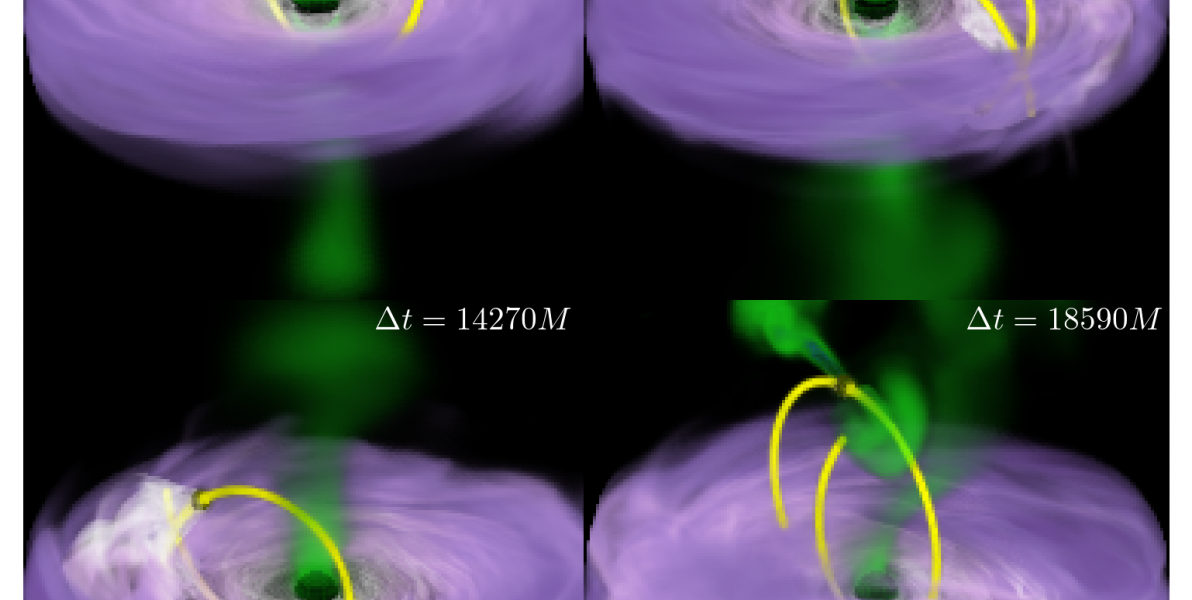
CITA researchers have the calculations and simulations to explain mysterious flashes from the galaxy OJ 287
Roughly twice every 12 years, from 3.5 billion light years away, the light equivalent of one trillion suns flashes in the night sky and then fades away over the next few months. It’s a phenomenon that astronomers have been documenting since the late 1880s, originating in a galaxy known…
Professor J. Richard Bond Accepts the 2025 Shaw Prize in Astrophysics

On October 21st CITA Professor J. Richard Bond accepted the 2025 Shaw Prize in Astrophysics, shared with Professor George Efstathiou from the University of Cambridge. The Shaw Foundation recognized the four 2025 Shaw Laureates at a special award presentation ceremony in the Grand Hall of the Hong Kong Convention and Exhibition Centre. The awards were presented by Professor Reinhard…
CITA Jamboree 2025

You are kindly invited to this year’s CITA National Jamboree meeting, scheduled on October 2-3! The Jamboree is an annual gathering of the CITA community from all over Canada, which provides an opportunity for new members to share their research with everyone. This year’s Jamboree will include a series of short informal presentations, a poster session, as well as social events.
Dates…
WORKSHOP: Unstable and Time-Variable Accretion Flows from Core to Disk to Star

Recent observations and simulations have revealed various non-smooth and irregular structures on both the prenatal core and the protoplanetary disk scales (e.g. streamers, arcs, rings, and cavities). The central forming stars and the outflows also reveal episodic signatures. Combined, these observational results imply that star formation is not as smooth and orderly as suggested by t…
Job App Hackathon 2025

What?
The CITA mentorship committee is once again hosting a Job App Hackathon! The CITA Job App Hackathon is an opportunity to prepare job application materials and get feedback from peers and mentors, including several CITA, Dunlap, and Physics faculty. In addition to co-writing sessions in the morning and afternoon, attendees will be able to sign-up for short one-on-one meetings wit…
- 1
- 2
- 3
- Older Posts →